


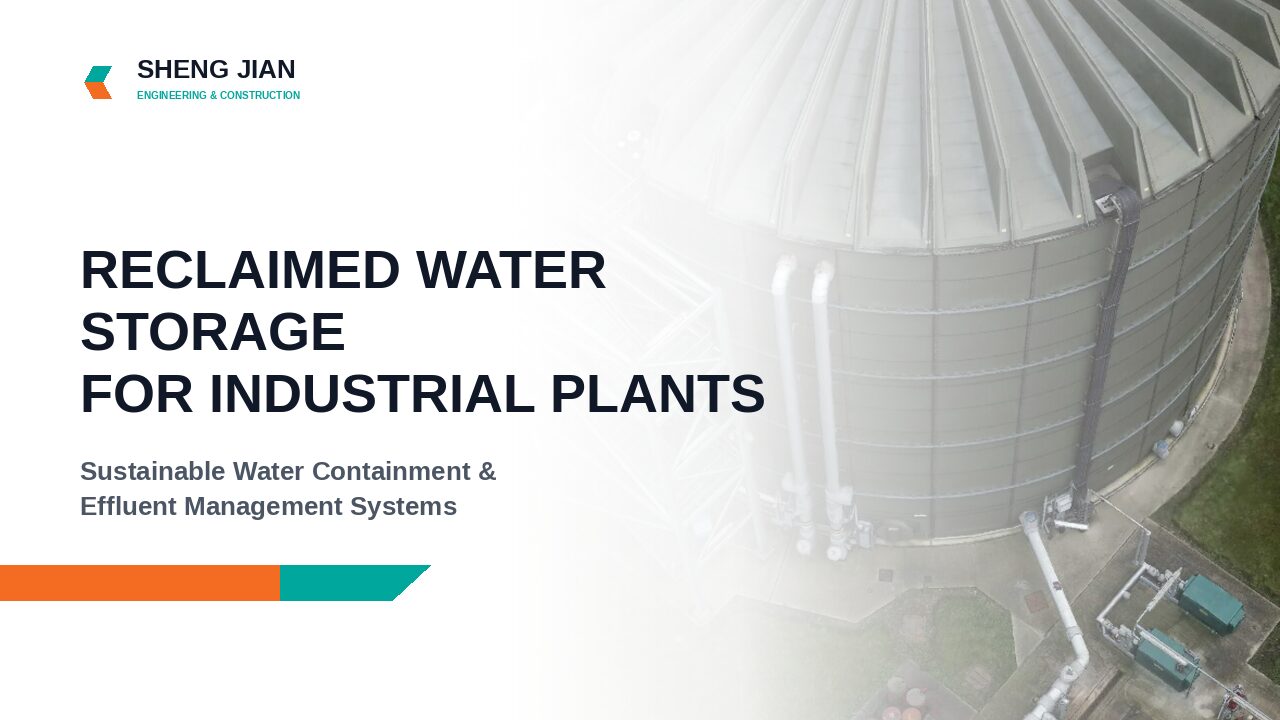
13 Aug Reclaimed Water Infrastructure in Manufacturing Plants
Water security has emerged as a vital operational consideration for industrial manufacturing facilities across Malaysia. Industrial hubs in Selangor, Johor, and Penang consume vast volumes of process water daily for cooling towers, boiler feed, chemical washing, and plant sanitation. As municipal water tariffs rise and seasonal drought risks impact supply stability, forward-thinking manufacturing plants are investing in on-site reclaimed water treatment and storage infrastructure.
Treating industrial wastewater and recycling treated effluent creates a closed-loop system that reduces operational costs, protects plant continuity during utility shutdowns, and upholds corporate Environmental, Social, and Governance (ESG) commitments.
Key Components of Industrial Water Reclamation Systems
Building an efficient on-site water recycling facility requires integrating advanced filtration technology with high-capacity, heavy-duty liquid storage assets.
Core infrastructure elements include:
- Advanced Filtration Modules: Ultrafiltration (UF) and Reverse Osmosis (RO) skids engineered in collaboration with water treatment leaders like Veolia Water Technologies
- Reclaimed Water Equalization & Storage Tanks: High-capacity carbon steel or stainless steel storage vessels designed for continuous treated water buffer retention
- Specialized Anti-Corrosion Tank Linings: Interior heavy-duty epoxy coatings designed to withstand chemical residues and variable pH balances
- Regulatory Compliance Frameworks: Meeting stringent discharge and re-use standards governed by state water authorities and national agencies like Indah Water Konsortium (IWK)
Structural & Engineering Considerations for Effluent Tanks
Industrial effluent and reclaimed water tanks must be engineered to handle harsh chemical chemistries. Unlike standard clean-water tanks, reclaimed water vessels require specialized material selection, continuous seam welding, and chemical-resistant linings to prevent internal corrosion, fluid leakage, and ground contamination.
Proper structural design—including roof truss support, floor plate anchoring, and external wind girder reinforcement—ensures storage tanks maintain structural integrity under full hydrostatic loads over decades of operation.
Build Resilient Water Infrastructure with SJEC
Sheng Jian Engineering & Construction (SJEC) designs, fabricates, and installs custom industrial water storage tanks, effluent containment vessels, and structural support frames tailored to manufacturing plant specifications.
Explore our custom steel fabrication solutions on our factory construction page or connect with SJEC to discuss your plant’s water security strategy.
FAQs
Why are manufacturing plants investing in reclaimed water systems?
Reclaimed water systems can reduce dependence on municipal water supplies by treating and reusing suitable process or wastewater streams. This can support operational resilience, water conservation, and broader ESG objectives.
What should be considered when designing reclaimed water storage tanks?
Tank design should consider the stored water chemistry, corrosion resistance, plate material, internal linings, continuous weld integrity, hydrostatic loads, roof support, anchoring, and external reinforcement required for long-term service.